
“Reduce 3,340 MW summer peak demand as first step to free up capacities” – PE2
MAKATI CITY, 30 April 2024 – The Philippine Energy Efficiency Alliance (PE2) called for a strategic shift in the country’s efforts to address power supply deficits by directing the focus toward management of the peak demand as a prerequisite to planning new generating and transmission capacities in the three main island grids.
PE2 President Alexander Ablaza stressed the imperative to initially exhaust all opportunities to flatten daily and seasonal peak demand curves prior to the planning of new power plants.
The non-profit PE2 believes that the thinning of power reserves every summer is always brought about by the vicious cycle wherein the end-use economy perpetually requires more energy when ambient temperatures soar. Ablaza explains, “The hotter the weather, the more energy is required to provide cooling through air conditioning and refrigeration.”
“PE2 believes that our limited power supply capacities can be optimally planned and dispatched if we try to flatten our steep peak demand curves as an initial step. There is so much talk about beefing up our thinning reserves by accelerating the addition of new power plants, but there are no conscious and concerted efforts toward shaving or shifting peak demand toward off-peak periods,” the PE2 president adds.
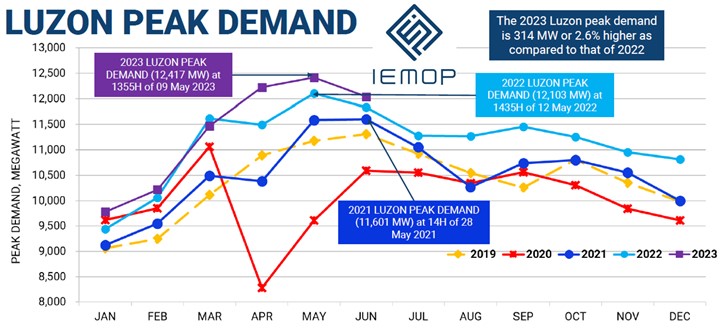
Ablaza observes that our grids always plan for the April-May summer peak demand for available generating capacities, which have recently risen by up to 27% higher than the annual low demand every January. For the Luzon grid alone in 2023, this 27% summer peak demand translates to 2,638 MW of additional generating and transmission capacity requirements. The Visayas and Mindanao grids have had milder 407 MW and 295 MW summer peak demand growth in 2023, respectively.
PE2 opines that a significant portion of the country-wide 3,340 MW rise in summer demand can actually be flattened through either peak-shaving or load-shifting toward off-peak hours. Permanent peak shaving can be achieved through aggressive replacement of energy-intensive systems in the commercial, industrial, transport and government sectors with more efficient technologies. On the other hand, a portion of the current peak demand can be shifted to off-peak hours or periods through a wide range of energy storage technologies, which now include thermal, kinetic and battery energy storage systems.
“While it would be theoretically impossible to achieve a totally flat demand curve, our energy-use economy should at least aspire to reduce the 3.3 GW bump in peak demand every summer,” Ablaza said.
Driven by the Department of Energy’s (DOE) growing enforcement of Republic Ac 11285, the Energy Efficiency and Conservation Act, more energy-efficient cooling technologies such as district or centralized systems, variable refrigerant flow, inverter and solar thermal cooling (not to be confused with solar photovoltaic systems) should replace conventional cooling systems to reduce peak demand for cooling especially through the mid-day and early afternoon peak hours of several highly urbanized cities.
The Energy Regulatory Commission (ERC) can even revisit studies to widen time-of-use differentials between peak and off-peak hours as a policy measure to incentivize private sector investments in load-shifting technologies such as energy storage systems.
PE2 is also hopeful that the anticipated policy issuance by DOE and ERC on the demand-side management provisions of RA 11285 will also boost such efforts to reduce daily and seasonal peak demand.
Through the long-term however, PE2 hopes that the virtual generation impacts of scaled-up energy efficiency deployment across various technologies and energy end-use sectors be planned as part of the energy mix which can significantly contribute to building up sufficient power reserve margins in the grid.
For more information, please contact secretariat@pe2.org


