
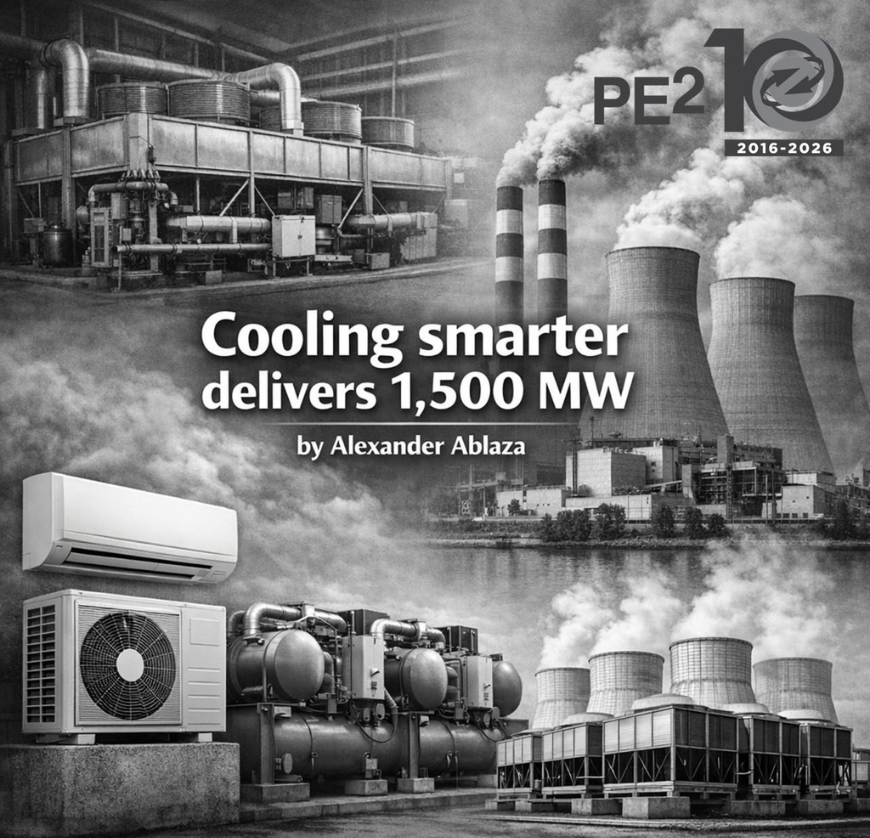
Cooling smarter delivers 1,500 MW
(PE2 Note: Makati Business Club, through its Business Matters column in the Philippine Daily Inquirer, featured PE2 president Alexander Ablaza’s article on the 1.5 GW cooling efficiency virtual power plant concept.)
Makati Business Club Opinion Column “Business Matters” by Alexander Ablaza (Philippine Daily Inquirer), 19 March 2026
Every summer, the Philippines braces for surging electricity demand. In 2023, the rise in heat index alone added 3,340 MW of peak demand across Luzon, Visayas, and Mindanao. Cooling loads—air conditioning and refrigeration—are now among the largest drivers of grid stress, forcing utilities to rely on expensive peaking power.
But what if we could build a 1,500 MW peaking plant without laying a single brick or importing a single barrel of oil? The answer lies in retrofitting no less than 6.05 million TR (tons of refrigeration) of existing cooling capacity in commercial buildings, industrial plants, government facilities and even in households. By improving the efficiency of these systems, we can reduce peak demand across all grids by 1.5 GW, thereby flattening our power demand curve from the coolest month of January to the hottest months of April and May each year.
This “virtual power plant” is not a futuristic concept—it is a proven opportunity. Cooling efficiency can be unlocked through chilled water plant upgrades, chiller optimization, inverter retrofits, district cooling systems, solar thermal integration and even mere replace of older fixed-speed air conditioners with inverter models. When deployed through energy service companies (ESCOs), these measures are financed off-balance sheet, with repayments drawn directly from verified energy savings. End-users avoid upfront costs, while ESCOs guarantee performance and share savings.
Globally, the ESCO market has grown to nearly USD 40 billion, with China and the US leading adoption. Super ESCOs are now operational in Saudi Arabia, the UAE, Kenya, Senegal, Canada, and the Philippines. Climargy, the world’s first private super-ESCO, was founded here to aggregate and scale projects like cooling retrofits. The model is clear: ESCOs transform efficiency into a bankable investment class.
The benefits of cooling retrofits extend far beyond the grid:
- Energy security: Deferring 1,500 MW of costly infrastructure investments in the power sector.
- Economic gains: Avoiding ₱279 billion in electricity purchases through 2030 and creating up to 351,000 green jobs.
- Climate impact: Up to 28 million tCO₂e reduction through 2030.
- Price stability: Increased efficiency investments decelerate the rise in energy prices by reducing demand for imported fuels and deferring infrastructure upgrades. In an era of global oil supply shocks, efficiency acts as a buffer, softening inflationary waves and stabilizing household and business costs.
To realize this opportunity, several recommendations emerge:
- Accelerate enforcement of RA 11285 – Ensure compliance among designated establishments, particularly MSMEs, now covered by reduced consumption thresholds.
- Scale ESCO-driven retrofits – Mobilize capital through shared savings performance contracts, PPPs, and joint ventures, enabling cooling upgrades without burdening end-users.
- Expand government leadership – Through aggressive policy actions by the Inter-Agency Energy Efficiency and Conservation Committee, the Government Energy Management Program is currently fast-tracking the phase-out of low-efficiency cooling systems across public facilities, setting the example for private adoption.
- Promote cooling-as-a-service models – District cooling and bundled efficiency services can aggregate demand, reduce costs, and simplify implementation.
- Build a culture of monitoring – Encourage households and small businesses to track cooling energy use, reinforcing behavioral change alongside technical upgrades.
- Leverage climate finance – Position cooling retrofits as a priority for international funding, given their dual impact on emissions reduction and energy resilience.
- Highlight price resiliency – Policymakers and investors should recognize efficiency as a hedge against volatility, ensuring that future oil shocks do not automatically translate into runaway electricity prices.
The urgency cannot be overstated. Cooling demand will only rise as urbanization accelerates and climate extremes intensify. Without intervention, peak demand will continue to strain grids, drive up electricity prices, and increase dependence on imported fuels. With intervention, however, we can transform cooling from a liability into an asset—an indigenous resource that delivers resilience, savings, and sustainability.
The Philippines can certainly opt to defer the addition of 1.5 GW of peaking generation, transmission and distribution capacities. We already have a 1.5 GW virtual power plant, hidden in plain sight, inside our air conditioners and refrigeration systems. All we need to do is unlock it.
Alexander Ablaza founded and currently leads the Asia-Pacific ESCO Industry Alliance (APEIA), the Philippine Energy Efficiency Alliance (PE2), and Climargy, the world’s pioneer private super-ESCO. His e-mail is aablaza@live.com
Source:
Philippine Daily Inquirer
https://plus.inquirer.net/opinion/cooling-smarter-delivers-1500-mw/
Authored by:
Alexander Ablaza


